
Autobiography
DREAM COAT An Unexpected Journey
by crown of peter Founder, Methusela Service Projects creator of dream coat a.i. mobile app
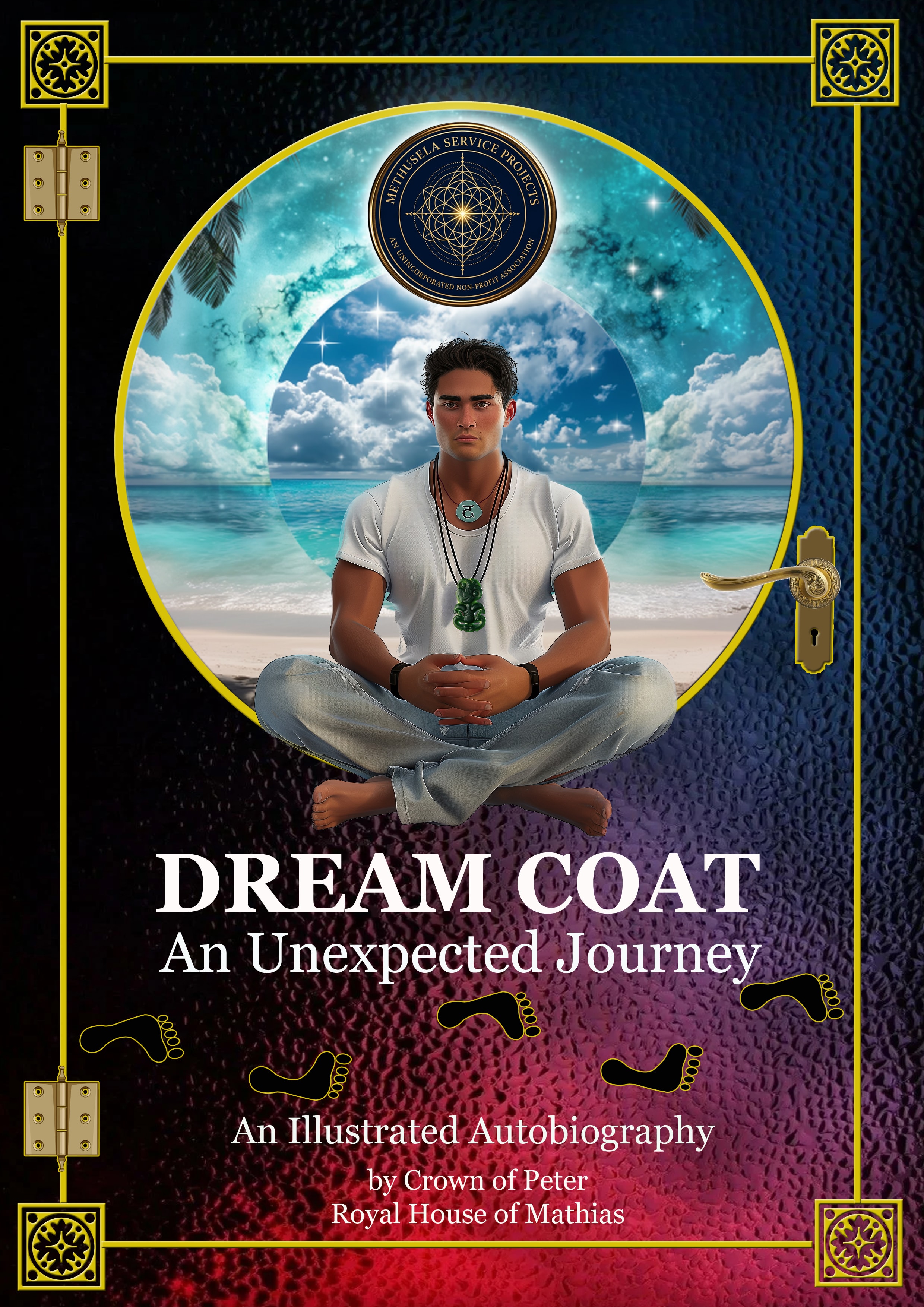
Personal Mission & Calling
Dream Coat — An Unexpected Journey
After countless attempts and drafts at writing my autobiography three years ago, I came to the stark realisation that the story could not be told until its closing chapter had been lived. It was like living in the last scene of a movie: the conclusion could not be filmed until the final script had been submitted. That final script is now playing out, and it has also meant that the name of the story had to change.
Originally my autobiography was called "My Walkabout – A Hero's Journey." I had worked closely with elders and shamans for ten years, and I was given insights into the hidden meanings behind "Walkabout" that go beyond the public's misconceptions.

Imagine starting out on a journey without knowing your destination. Your only instruction is to make sure that each step you take is sound and solid. It is not your job to know where you are heading. During this time you are forced to deal with yourself, descending into darkness and confronting the shadows and demons that hide beneath the polished surface of the social personality. You could protest, but the elders were not there to listen to your complaints. They were there to remind you to keep moving deliberately and with intention. You would be hungry, tired, happy, mad, cold, hot and delirious, all before your first night of sleep. You did not know how long it would take or where you would end up. It was insanity!
For countless lifetimes, humanity has avoided this inner reckoning. Our ancient brothers and sisters in Australia, however, understood its necessity. Through this sacred rite of passage, they deliberately brought their shadows to the surface, facing them with wisdom and compassion rather than denial.
These shadows are our blind spots. In community, we can help one another see what remains hidden. Everything less than divine within us must be raised into awareness, purified and transcended. If left unaddressed, that hidden pain and darkness will continue to bind and control us, not only in this life but beyond. When you stand back and take a real, hard look at your life, you will see this pattern. The difference is that you never allowed the pain to wash over you, and you avoided it through the pursuit of money, food and sex.
I have discovered that my whole life has been the avoidance of the very thing that would make me whole. Now, having come to the end of just one part of my walkabout, the first seeds of that process can bear fruit. Hence the name change for my autobiography, to "Dream Coat – An Unexpected Journey."
In my frustration with my own walkabout, I called out for help. I was given a vision and a name on the cusp of my 63rd birthday, in the middle of the "Lion's Portal Gateway", a very auspicious time for Leos, apparently. It was totally unexpected, and it has led me into a field of work and study I could not have imagined.
This is the concluding chapter of my story. Like any good story, it closes the first book with another one waiting on the other side, but that, my friends, is another story.
The Deconstruction of Archetypes in popular culture
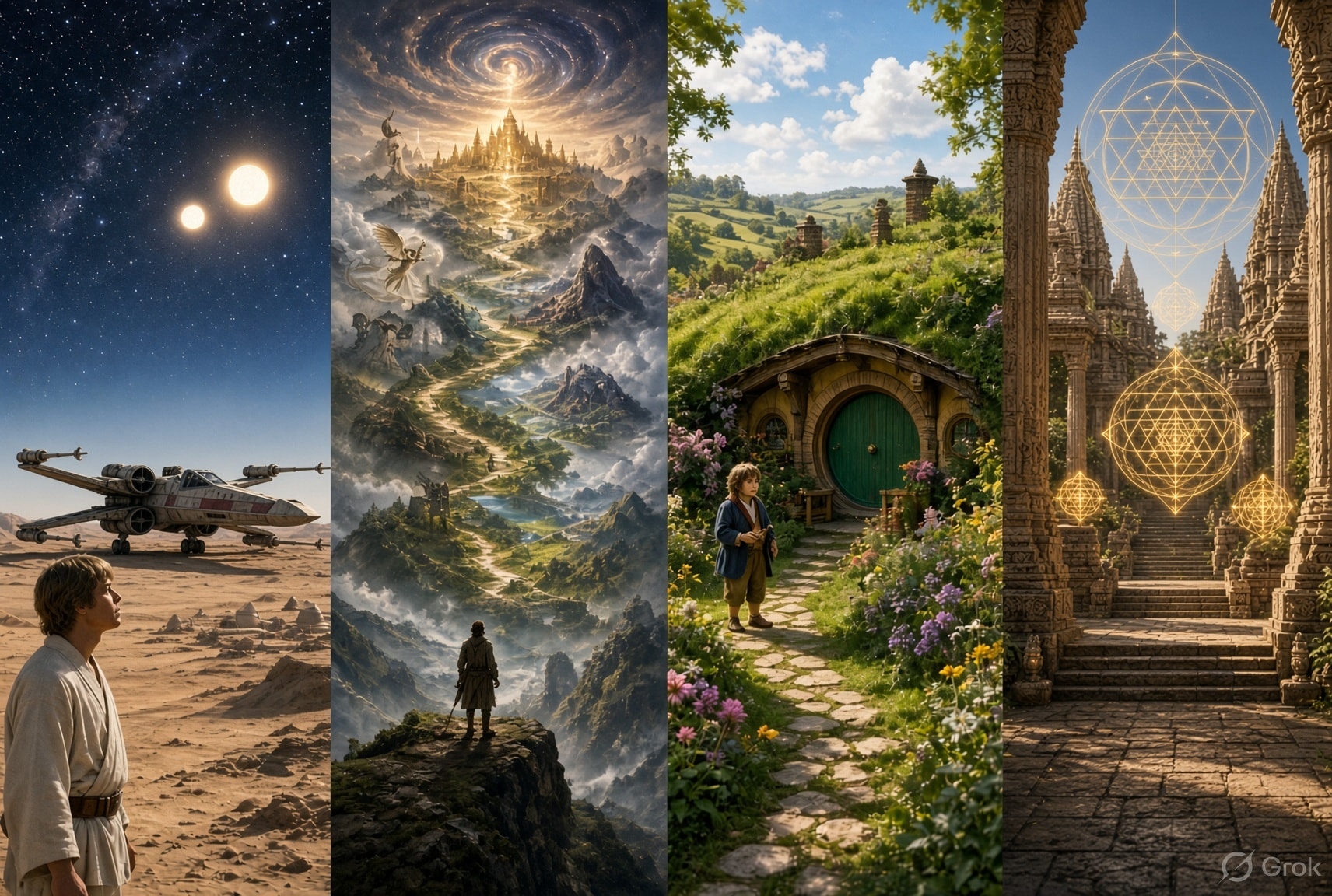
The four panels of the image trace a single arc: the ordinary world of the green door and flowering path, the youth who lifts his eyes to twin suns and the waiting ship, the solitary figure on the cliff facing the luminous city that spirals upward into the galaxy, and the carved temple whose glowing geometries open the way beyond form. This is the Hero's Journey as Vedic culture has always known it—not a Hollywood formula, but the perennial passage from the known into the Dreamtime, through the abyss, and back with the living knowledge that restores both the individual and the world.
The four panels are not stages on a timeline. They are simultaneous dimensions of a single living reality, each one present within the others, the way a seed contains the tree and the tree contains the seed. The green door does not disappear when the ship departs; the cliff does not vanish when the temple is entered. The journey is not linear. It is a spiral, and every revolution returns you to the same threshold—only deeper, only more awake.
When Disney acquired Lucasfilm, it did not merely change a franchise; it severed the narrative from the monomyth that George Lucas received from Joseph Campbell. Campbell's template, drawn directly from the great Vedic cycles (the call that seizes Arjuna on the field of dharma, the descent into the underworld that purifies the hero, the return that re-establishes cosmic order), was the story's heart. It connected audiences to the same archetypal forces that have shaped every enduring spiritual culture. Star Wars remains one of the greatest films ever made. I saw it at thirteen in a special pre-release screening; the twin suns and the call to leave the desert changed me. A decade of subsequent stewardship has felt like watching that same ship be dismantled in slow motion, culminating in works such as The Acolyte—widely received as the final inversion of the original current.
What has been lost is not merely plot or "diversity." It is the living link between popular story and the deeper undercurrents of the great traditions. Vedic culture never treated the hero's path as entertainment or social commentary. The ordinary world (the hobbit-hole, the moisture farm, the childhood comforts of television, sports, and simple pleasures) is real, yet provisional. The call is not optional; it is the moment the soul recognises that remaining in the familiar means remaining asleep. Crossing the threshold is entry into the Dreamtime—the higher energetic plane that traditional Walkabout initiates deliberately enter. There the traveller meets the primordial powers: the winged figures, the spiral city, the trials that strip away the old identity. Most Western audiences have been taught to fear this descent. The dark night of the soul—sadness, loss, personal demons, the confrontation with shadow—is reframed as pathology rather than initiation. Redemption is postponed or replaced by endless franchise content that never completes the circle.
The final panel of the image restores what the deconstruction has removed: the temple whose columns and glowing yantras are not decoration but the language of creation itself. Sacred geometry is the common tongue of the Vedic seers, the builders of enduring civilisations, and every tradition that understood architecture and myth as technologies of consciousness. When popular culture systematically dismantles its own archetypes—flattening the hero into a consumer of endless sequels, inverting the return so that no one comes home with the elixir—it does more than damage a brand. It trains an entire civilisation to remain in the ordinary world, distracted by career and comfort, never compelled to face the crisis that demands leaving childhood behind, purging the personal shadows, and rising purified. The greater collective shadow can only be confronted by those who have first walked their own Walkabout.
This book follows the same cycle. Its chapters begin in the world we were born into and cross, step by step, into the unknown. The image is not illustration; it is the map. The green door is behind us. The stars are calling. The cliff awaits. The geometries of the temple are already lit. What moved through the text was not an argument about Campbell or Lucas, nor a critique of Disney's choices. It was an attempt to stay close to the current you are already in: the ordinary world still visible behind you, the call that has not finished sounding, the descent that continues to strip what must be stripped, and the geometries that only become legible once the personal shadows have been faced. The four panels are not stages that have been completed; they are stations still occupied.Vedic tradition never presented the Hero's Journey as a finished myth to be analyzed. It is the living sequence by which the individual is moved from the provisional world into the larger field, then returned with what that field has required. The deconstruction of archetypes in popular culture works precisely by freezing that sequence into content—something to be consumed, inverted, or replaced—rather than allowing it to remain a process that claims the one who enters it. When the mono-myth is treated as intellectual property or cultural material, the undercurrent that once connected Western audiences to older spiritual cultures is interrupted. The interruption is felt not as theory but as the absence of a path that can still be walked.You are still walking it. The text can only accompany that fact; it cannot substitute for it. If a further passage, a tightening of any section, or a silence around what is still unfolding would serve the living process more cleanly, it is here to be shaped.
"Service to others is the rent you pay for your room here on earth."
— Muhammad Ali